
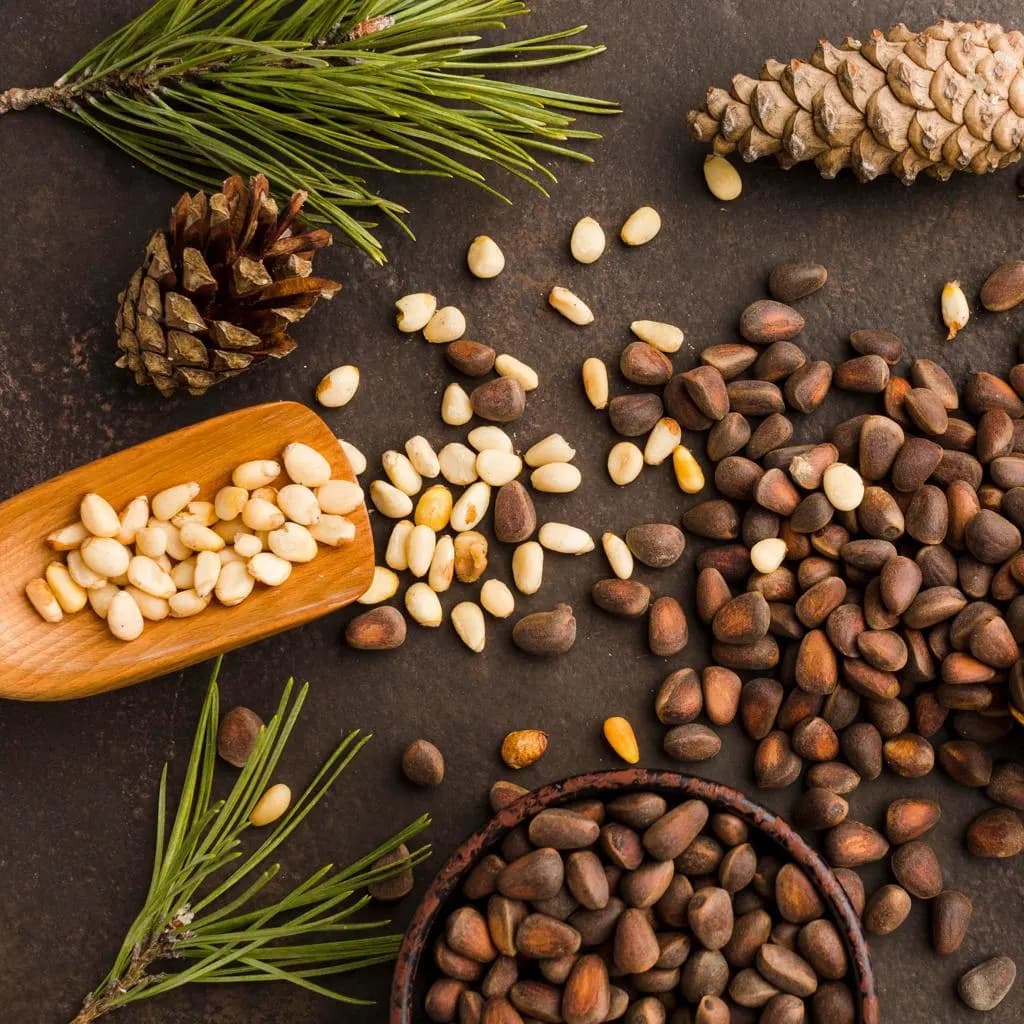
Chilgoza is called pine nuts in English. More specifically, Chilgoza refers to the edible seeds of the Chilgoza pine tree (Pinus gerardiana), a species associated with mountainous regions of Pakistan and neighboring countries.
Chilgoza is valued for its rich, buttery flavor and nutritional content. It naturally contains unsaturated fats, plant-based protein, and minerals such as magnesium, zinc, and phosphorus.
People often search for Chilgoza benefits for men, Chilgoza benefits for women, Chilgoza during pregnancy, and Chilgoza nutritional value. While pine nuts can contribute useful nutrients to a balanced diet, there is no strong clinical evidence that eating Chilgoza specifically improves fertility, testosterone levels, or treats medical conditions.
In this guide, discover:
- What Chilgoza is called in English and Urdu.
- The nutritional value and potential benefits of Chilgoza.
- What research supports about Chilgoza benefits for males and females.
- The Chilgoza pine tree and where it grows.
- Roasted versus unroasted Chilgoza.
- How to eat, store, and choose good-quality pine nuts.
- Important side effects, allergies, and pregnancy considerations.
- For current product prices and available quantities, visit our Chilgoza Price in Pakistan guide.
What Is Chilgoza?
Chilgoza (چلغوزہ), sometimes spelled Chilghoza, Chalghoza, or Neoza, is an edible seed harvested from a particular species of pine tree.
Although people commonly call it a dry fruit or nut, Chilgoza is botanically a seed.
The edible kernel sits inside a hard outer shell. Once removed, the kernel has a pale color, a tender texture, and a rich flavor.
Chilgoza is enjoyed in Pakistan as a snack, especially during the colder months. It may be eaten unroasted, lightly roasted, or added to selected foods.
Unlike common peanuts or almonds, Chilgoza comes from a relatively limited range of mountain forests. Its harvesting and processing requirements help explain why it is often expensive.
Chilgoza English and Scientific Names
Description | Name |
English Name | Pine Nut |
Specific English Name | Chilgoza Pine Nut |
Urdu Name | چلغوزہ |
Roman Urdu | Chilgoza / Chilghoza |
Scientific Name | Pinus gerardiana |
Tree Name | Chilgoza Pine |
Plant Family | Pinaceae |
Are Chilgoza and pine nuts the same?
Yes, Chilgoza is a type of pine nut. However, not every pine nut sold around the world comes from the Chilgoza pine tree.
Several pine species produce edible seeds that are marketed as pine nuts. They can differ in shape, size, flavor, and origin.
The term Chilgoza usually refers to the seeds associated with Pinus gerardiana, rather than every commercial pine nut species.
This distinction is useful when comparing pine nuts from Pakistan with imported varieties.
Chilgoza Pine Tree: Where Does Chilgoza Grow?
The Chilgoza pine tree, Pinus gerardiana, is an evergreen conifer found in mountainous parts of South and Central Asia.
Its natural distribution includes northern Pakistan, eastern Afghanistan, parts of the western Himalayas, and neighboring regions.
The tree is adapted to relatively dry mountain environments, often growing at elevations of approximately 2,000–3,350 meters.
What does a Chilgoza tree look like?
A mature Chilgoza pine has a woody trunk, needle-like leaves, branches, and seed-bearing cones.
Its characteristics include:
- Long evergreen needles arranged in groups of three.
- A broad or irregular crown depending on growing conditions.
- Woody cones containing edible seeds.
- A preference for particular mountain forest environments.
- Slow natural regeneration in some areas.
The seeds develop inside cones. Harvesting them involves collecting suitable cones, extracting the seeds, and preparing them for sale.
Is Chilgoza grown in Chitral?
Chilgoza is associated with the wider mountain landscapes of Pakistan and neighboring regions. Important documented habitats include mountain areas of northern and western Pakistan.
However, a product described as Chitrali Chilgoza should have its specific geographic origin verified rather than assumed from the seller's location or branding.
Why are Chilgoza pine forests important?
Chilgoza forests contribute to mountain ecosystems and can provide income opportunities for forest-dependent communities.
The species is also affected by pressures such as excessive seed harvesting, habitat change, and tree cutting. Conservation organizations classify Pinus gerardiana as Near Threatened.
Responsible harvesting and forest management matter because the future supply of Chilgoza depends on healthy, regenerating pine forests.
Chilgoza Nutrition: What Nutrients Does It Contain?
Chilgoza is valued for its rich flavor, but pine nuts also contain fats, protein, minerals, and other nutrients.
Most of their calories come from fat, including unsaturated fatty acids.
Pine nuts contain nutrients such as:
- Protein
- Unsaturated fats
- Magnesium
- Phosphorus
- Zinc
- Copper
- Manganese
- Vitamin E
Pine nut nutritional value per 100g
Nutrient | Approximate Amount |
Calories | 673 kcal |
Protein | 13.7 g |
Total Fat | 68.4 g |
Carbohydrates | 13.1 g |
Dietary Fiber | 3.7 g |
Chilgoza Benefits: What Does Nutrition Science Support?
People often search for Chilgoza health benefits, including its role in energy, heart health, skin, and general nutrition.
The most reliable way to understand these claims is to distinguish established nutritional facts from benefits that have not been directly demonstrated in human studies of Chilgoza.
1. Provides dietary energy
Chilgoza contains substantial fat and calories, making it an energy-dense food.
A small serving can be a convenient addition to a snack, particularly when combined with fruit or other foods.
However, eating more Chilgoza does not automatically make a person's energy levels better. Total diet, activity, and individual needs still matter.
2. Contains unsaturated fats
Pine nuts contain unsaturated fatty acids.
Replacing some sources of saturated fat with unsaturated fats can be part of a heart-conscious dietary pattern.
This does not mean Chilgoza itself is proven to prevent or treat heart disease.
3. Contributes plant-based protein
Chilgoza contains protein, which the body uses for maintaining and repairing tissues.
It can contribute to overall protein intake, although it should not be treated as a replacement for a varied diet.
4. Supplies important minerals
Pine nuts contain minerals including magnesium, zinc, copper, manganese, and phosphorus.
These nutrients participate in normal physiological processes such as metabolism and cellular function.
The contribution of any one serving depends on its size and the actual nutritional composition of the product.
5. Can be part of a balanced snack
Chilgoza can be eaten alongside fresh fruit, yogurt, or other foods.
Its fat and protein content make it a useful ingredient in varied snacks and meals.
There is no need to eat it in large quantities to enjoy its taste or nutritional contribution.
Chilgoza Benefits for Men and Women: Are They Different?
Searches such as Chilgoza benefits for male, Chilgoza benefits for female, and benefits of Chilgoza dry fruit are common.
However, there is no strong evidence that Chilgoza provides unique, clinically proven benefits specifically for men or women.
Both men and women can obtain nutrients from pine nuts as part of a balanced diet.
Does Chilgoza improve male fertility?
Some websites claim Chilgoza improves testosterone, sexual performance, or male fertility.
These claims should be treated cautiously.
Although nutrients such as zinc are relevant to normal reproductive function, that does not establish that eating Chilgoza improves fertility or treats reproductive problems.
Anyone experiencing fertility concerns should seek appropriate medical advice rather than relying on a particular food.
Is Chilgoza good for women?
Chilgoza provides calories, fats, protein, and minerals that may contribute to a varied diet.
However, claims that it specifically regulates hormones or treats women's health conditions are not established by strong clinical evidence.
Chilgoza during pregnancy
Chilgoza should not be promoted as a pregnancy treatment or fertility aid.
Pregnant individuals with food allergies, dietary restrictions, or medical concerns should consult their healthcare professional about suitable foods.
Roasted vs Unroasted Chilgoza: Which Is Better?
Both roasted and unroasted Chilgoza have their place.
The better option depends primarily on taste, intended use, freshness, added ingredients, and personal preference.
FeatureRoasted ChilgozaUnroasted ChilgozaTasteMore toasted and aromaticMilder, naturally nuttyTextureOften firmer or crispierUsually softerProcessingHeated during roastingNot intentionally roastedBest usesSnacking and garnishingSnacking, recipes and home roastingNutrientsGenerally similar, though processing affects some componentsGenerally retains its unroasted profileStorageDepends on processing and packagingDepends on processing and packaging
Does roasting destroy Chilgoza nutrients?
Roasting can alter moisture content, flavor, and some heat-sensitive compounds.
However, roasted nuts are not automatically nutritionally inferior to unroasted nuts. Overall differences depend on the roasting temperature, duration, and specific nutrient.
For most buyers, freshness, food safety, and the ingredients added during processing matter more than assuming one form is universally healthier.
Which should you buy?
Choose roasted Chilgoza if you prefer a toasted flavor and a snack that requires little preparation.
Choose unroasted Chilgoza if you prefer its milder taste or want more control over how it is prepared at home.
If either variety has been salted or seasoned, check the ingredients before buying.
Roasted vs Unroasted Chilgoza
Feature | Roasted Chilgoza | Unroasted Chilgoza |
Taste | Toasted, aromatic | Mild, nutty |
Texture | Crunchier | Softer |
Processing | Heat-roasted | Not roasted |
Nutrients | Some heat-sensitive nutrients may change | Retains unroasted nutritional profile |
Best For | Snacking, garnishing | Snacking, cooking, home roasting |
Storage | Depends on packaging | Depends on packaging |
Chilgoza With Shell vs Without Shell
Another important buying consideration is whether Chilgoza comes with its outer shell.
With-shell Chilgoza
The pack includes both the hard shells and the kernels inside.
Buyers must remove the shell before eating.
Because the total weight includes shell material, a 500g with-shell pack does not contain 500g of edible kernels.
Without-shell Chilgoza
Also called Chilgoza kernels or Chilgoza Magaz, this variety has the hard outer shell removed.
It is convenient for cooking and eating, but the price per kilogram may be higher.
When comparing products, check whether the advertised weight refers to whole in-shell nuts or shelled kernels.
This distinction can make a substantial difference to actual value.
Why Is Chilgoza So Expensive in Pakistan?
People frequently wonder why Chilgoza costs more than many other dry fruits.
Several factors help explain its price:
Limited growing regions: Chilgoza pine trees thrive in specific mountain habitats rather than ordinary agricultural fields.
Harvesting requirements: Pine cones must be gathered and the edible seeds extracted.
Processing: Shell removal, sorting, grading, and packaging require additional work.
Seasonal availability: Supply changes with harvest conditions, regional production, and market demand.
Transportation: Moving produce from remote mountain areas to urban markets adds costs.
Product variation: Grade, origin, size, shell condition, and roasting can affect retail prices.
Prices may also vary between Lahore, Karachi, Islamabad, Chitral, and other locations due to seller practices and delivery costs.
For current product listings and available pack sizes, see our Chilgoza Price in Pakistan guide.
How to Eat Chilgoza: Easy Everyday Uses
Chilgoza is versatile and does not require a complicated recipe.
Eat it as a snack
Enjoy a small portion of edible kernels on their own.
Add it to rice dishes
Use a few kernels as a garnish for suitable rice recipes.
Mix it into desserts
Pine nuts can add texture and flavor to selected traditional sweets and baked foods.
Sprinkle it over salads
Lightly toasted kernels can provide an appealing contrast to fresh vegetables.
Add it to homemade snack mixes
Combine Chilgoza with other nuts or dried fruits according to your preferences.
The most important thing is to enjoy it as part of a balanced diet rather than treating it as a medicine.
How Much Chilgoza Should You Eat Daily?
There is no universal medically established daily quantity specifically for Chilgoza.
For general portion planning, a small handful of edible kernels—approximately 25–30g—is a practical example of a nut serving for many adults.
That is not a required amount or a medical recommendation.
Individuals with specific nutritional goals, allergies, or health conditions may need different dietary guidance.
Remember that the serving weight refers to edible kernels, not the weight of the shells.
Chilgoza Side Effects and Precautions
Chilgoza is a food, but there are a few considerations worth knowing.
1. Allergic reactions
Pine nuts can trigger allergic reactions in some individuals.
People with known pine nut allergies should avoid them. Anyone with a history of serious food allergies should seek professional advice about unfamiliar nuts and seeds.
Difficulty breathing, throat swelling, or other signs of a severe allergic reaction require emergency medical attention.
2. High calorie content
Pine nuts are energy-dense.
Eating large portions frequently can increase total calorie intake, which may matter for individuals managing their diet.
3. Temporary bitter or metallic taste
A small number of people report an unpleasant bitter or metallic taste after consuming certain pine nuts.
This is sometimes called pine mouth syndrome.
It may appear after a delay and can last several days or longer. The phenomenon has been associated particularly with certain pine nut species, and it should not automatically be attributed to Chilgoza pine nuts.
If symptoms are persistent, severe, or concerning, seek medical advice.
4. Freshness and rancidity
Pine nuts contain substantial oils, which makes proper storage important.
Old or poorly stored kernels can develop an unpleasant smell or flavor.
Do not eat products that smell rancid, appear moldy, or show other clear signs of spoilage.
How to Store Chilgoza in Pakistan's Weather
Because Chilgoza contains natural oils, heat and moisture can affect its quality.
Storage deserves particular attention during Pakistan's warmer months.
For short-term storage, keep the product in a clean, airtight container away from heat, sunlight, and humidity.
For longer storage, refrigeration or freezing can help maintain quality, especially for shelled kernels.
Use sealed, food-safe packaging to prevent moisture and unwanted odors from reaching the nuts.
Always follow any specific storage instructions provided by the producer or retailer.
If a pack has been opened, check its freshness before use.
How to Identify Good-Quality Chilgoza
Appearance alone cannot prove that Chilgoza is fresh, safe, or from a particular region, but several practical checks can help.
Look for:
- Clear product labeling.
- Accurate net weight.
- Stated shell condition.
- Information about roasting or added ingredients.
- Suitable, intact packaging.
- A normal, pleasant nutty smell.
- No visible mold or obvious spoilage.
- Reliable seller information.
Avoid treating simple home tests as definitive proof of purity, origin, or freshness.
For higher-value purchases, traceability and trustworthy sourcing information are more useful than exaggerated marketing claims.
Frequently Asked Questions About Chilgoza
What is Chilgoza called in English?
Chilgoza is called a pine nut in English. More specifically, it is the edible seed of the Chilgoza pine, Pinus gerardiana.
What is the English name of the Chilgoza tree?
The tree is commonly called Chilgoza pine or Chilghoza pine.
Is Chilgoza a dry fruit or a seed?
Botanically, it is a seed. In Pakistan, it is commonly sold and discussed as a dry fruit or nut.
What are the main benefits of Chilgoza?
Chilgoza provides dietary energy, unsaturated fats, protein, and minerals. Its nutritional contribution is best understood as part of a varied, balanced diet rather than as a specific medical treatment.
Is roasted Chilgoza better than unroasted Chilgoza?
Neither is universally better. Roasted Chilgoza has a toasted taste, while unroasted Chilgoza has a milder flavor. Quality, processing, ingredients, and personal preference matter.
What is the scientific name of Chilgoza?
The Chilgoza pine tree is scientifically known as Pinus gerardiana.
Why is Chilgoza expensive?
Limited growing areas, mountain harvesting, processing, seasonal supply, and transportation all contribute to the price.
Is Chilgoza good for men?
It contains useful nutrients, but claims that it specifically boosts testosterone or treats infertility are not established by strong clinical evidence.
Can Chilgoza be eaten every day?
For people who tolerate pine nuts, a moderate amount can be part of a varied diet. Appropriate portions depend on individual dietary needs.
Where can I check Chilgoza prices in Pakistan?
Prices vary by weight, grade, processing, and seller. You can compare available products through the Chitral Hive Chilgoza price guide.
Final Thoughts
Chilgoza is much more than an expensive dry fruit.
It comes from a distinctive mountain pine tree, has an important place in regional food traditions, and provides a combination of dietary fats, protein, and minerals.
Understanding its English name, nutritional value, origin, and preparation methods can help people appreciate what makes Chilgoza different from other nuts and seeds.
Whether you prefer roasted or unroasted Chilgoza, the best approach is to choose a clearly labeled, properly stored product that suits your taste and budget.
If you're comparing pack sizes or shopping for pine nuts online in Pakistan, explore the available Chilgoza products at Chitral Hive.
