
Inside Chitral's Beekeeping Heritage: How Our Honey Is Made From Mountain to Jar
April 19, 2026
Chitral Hive
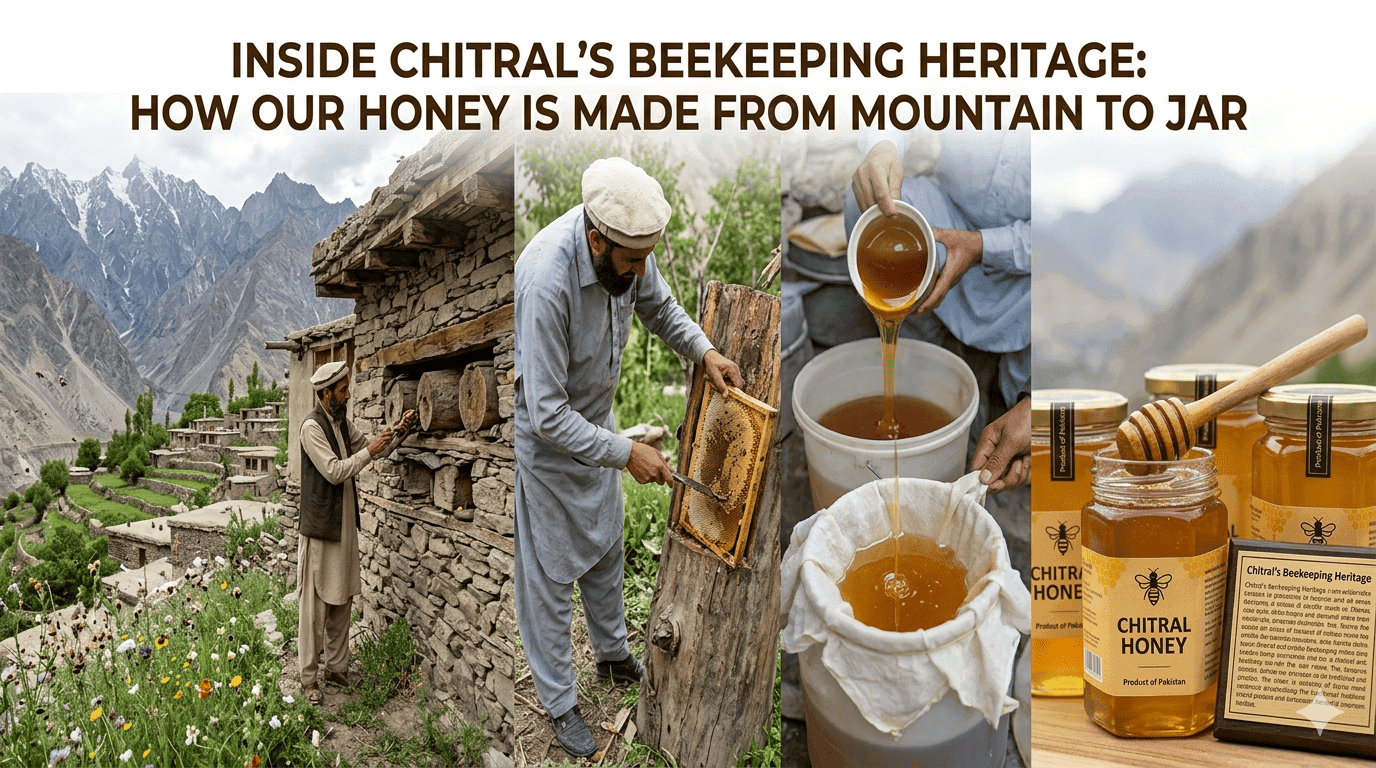
A Valley That Has Always Hummed
Drive north from Peshawar for eight hours — past the Lowari Tunnel, through switchback mountain roads that cling to the sides of the Hindu Kush — and you arrive in Chitral: a district of jaw-dropping beauty, ancient cultures, and extraordinarily rich biodiversity. Here, nestled between the peaks, beekeeping is not a modern enterprise. It is a way of life passed down across generations.
For centuries, Chitrali families have kept bees in hand-carved wooden log hives, positioned beside their homes, orchards, and high-altitude summer pastures. Honey was currency, medicine, and celebration all at once — gifted at weddings, given to the sick, and traded across the passes to Afghanistan and Central Asia.
The Landscape That Makes the Difference
The secret to Chitral's honey is its geography. The district sits between 1,100 and over 7,700 metres above sea level, creating a staggering range of microclimates and flora zones within a single region:
- Lower valleys bloom with fruit orchards — apricot, cherry, mulberry, and walnut — providing rich spring nectar
- Mid-altitude slopes host wild thyme, clover, wildflowers, and medicinal herbs including Himalayan herbs found nowhere else in South Asia
- High pastures above 2,500 metres erupt with summer wildflowers during the brief warm months, creating the most complex and aromatic honey of all
- Sidr groves in sheltered valleys provide the precious late-season Sidr nectar that makes our signature Sidr honey possible
No agricultural chemicals reach these elevations. No industrial pollution touches these blooms. The air is clean, the water is glacial, and the ecosystem is as close to pristine as any beekeeping landscape on earth.
Our Beekeeping Partners
Chitral Hive works with over 40 beekeeping families across Chitral, the Kalash Valleys, Mastuj, and Torkhow. These are not commercial apiaries. They are family-run operations where knowledge is oral, where children learn to read hives by watching their fathers, and where each beekeeper manages anything from five to sixty hives as part of a broader mountain livelihood.
We visit our partner beekeepers personally each season. We discuss hive health, forage conditions, and harvesting timing together. We pay a fair premium — well above market rates — because we understand that the quality of our honey begins with the security and motivation of the people who tend the bees.
The Harvesting Process: Slow, Careful, Respectful
At Chitral Hive, honey harvesting follows a philosophy of minimum intervention:
- Timing: We harvest only when the honey is fully capped — meaning bees have sealed the cells with wax, indicating the honey has reached the correct low-moisture level for long-term preservation. Harvesting uncapped honey is a common shortcut that produces inferior, fermentation-prone honey. We never do it.
- Smoke-free preference: Many of our partners use minimal smoke and instead rely on calm, slow movements and experience built over decades. This reduces bee stress and produces calmer, higher-quality comb.
- Cold extraction: Honey is extracted using a hand or electric centrifuge at ambient mountain temperatures — never heated. Heat above 40°C begins destroying enzymes and aromatic compounds. Our honey is never heated at any stage.
- Minimal filtration: We pass honey through a coarse mesh to remove large wax pieces only. Fine filtration is deliberately avoided to preserve pollen, propolis particles, and the full natural texture of mountain honey.
Quality Assurance: From Hive to Lab
Once collected, honey is transferred to our facility where each batch undergoes:
- Moisture content testing (target: below 18% for optimal preservation)
- HMF (Hydroxymethylfurfural) testing to confirm the honey has not been heated or artificially processed
- Pollen microscopy to verify floral source and confirm single-origin claims
- Adulteration testing to rule out added sugar syrups or rice syrup adulterants
Only honey that passes all checks is packed into our signature glass jars, labelled with valley of origin and harvest season, and dispatched to your door.
Why This Story Matters to You
Every jar of Chitral Hive honey represents not just a product but an entire ecosystem of care — the beekeeper who rose at dawn to tend his hives, the bee that travelled kilometres through mountain meadows collecting nectar, the wildflower that bloomed briefly at altitude before the snows returned. When you choose Chitral Hive, you are sustaining all of that.
You are also supporting a community where honey income supplements the livelihoods of families in one of Pakistan's most beautiful but economically marginalised regions. We believe good business and genuine care for people and nature are not opposing forces — they are the only way forward.
🏔️ Taste the mountain. Support the community. Order your jar of Chitral Hive raw honey and be part of a story that starts 7,000 feet above sea level.