How to Identify Pure Chitrali Salajit vs Fake: 7 Tests Every Pakistani Buyer Must Know (2026)
April 14, 2026
Chitral Hive
The Salajit Fraud Crisis Nobody Is Talking About
Pakistan's online market for Salajit (also written as Shilajit, Salajeet, or Silajit) has exploded in recent years. Search interest for "buy Salajit online Pakistan" has grown dramatically, and dozens of sellers have rushed in to meet demand — many of them selling adulterated, diluted, or outright fake products.
The consequences are not just financial. Fake Salajit often contains:
- Coal tar or asphalt to mimic the dark color and resinous texture
- Heavy metals like lead and arsenic from improper sourcing or adulteration
- Soil and fulvic mineral powder mixed with fillers and binders
- Artificial humic acid powder that resembles real Salajit visually but has no bioactive compounds
In short, buying the wrong Salajit does not just waste your money — it can actively harm your health.
This guide gives you the exact knowledge you need to distinguish genuine Chitrali Salajit from the sea of fakes, whether you're shopping online or in a market.
What Is Pure Chitrali Salajit — And Why Chitral Specifically?
Salajit is a naturally occurring exudate that seeps from rock faces at high altitudes, formed over centuries through the slow biological compression of plant and organic matter between mountain layers. It is found in several mountain ranges globally, but the Hindu Kush mountains of Chitral, Pakistan are recognized as producing some of the world's most mineral-rich and potent varieties.
Why Chitral specifically?
- Altitude: Chitrali Salajit is harvested above 3,000 meters, where extreme cold, low oxygen, and high UV radiation contribute to unique bioactive compounds
- Geology: The specific limestone and metamorphic rock formations in Chitral create a mineral profile unmatched by most other sources
- Tradition: Chitrali harvesters have used knowledge passed through generations to identify the highest-quality seeps and collect them at the optimal time (usually late spring and summer when heat causes the resin to flow)
- Purity: The remote, unpopulated valleys of Chitral mean minimal industrial or agricultural contamination of the surrounding environment
The local Khowar name — "Zomu Ashro" (tears of the mountains) — captures something important: genuine Chitrali Salajit is a product of extraordinary natural processes, not a commodity that can be manufactured cheaply.
The Chemical Composition of Real Salajit
Before understanding how to test for authenticity, it helps to know what genuine Salajit actually contains:
Fulvic Acid (60–80%): The primary bioactive compound. A powerful electrolyte that transports nutrients into cells and removes toxins. High-quality Chitrali Salajit has a fulvic acid content between 60–80%.
Humic Acid: Supports gut microbiome health, reduces inflammation, and binds to heavy metals for safe elimination.
Dibenzo-Alpha-Pyrones (DBPs): Antioxidant compounds unique to genuine Salajit — these cannot be synthesized artificially, making their presence one of the best markers of authenticity.
Trace Minerals: Iron, zinc, calcium, magnesium, copper, selenium, and over 80 other trace minerals in ionic (bioavailable) form.
Bioactive Peptides: Small protein fragments with anti-inflammatory and adaptogenic properties.
A fake or adulterated product — even one made from powdered humic/fulvic acid — will lack the full spectrum of DBPs, natural peptides, and the specific mineral ratios of genuine mountain-sourced Salajit.
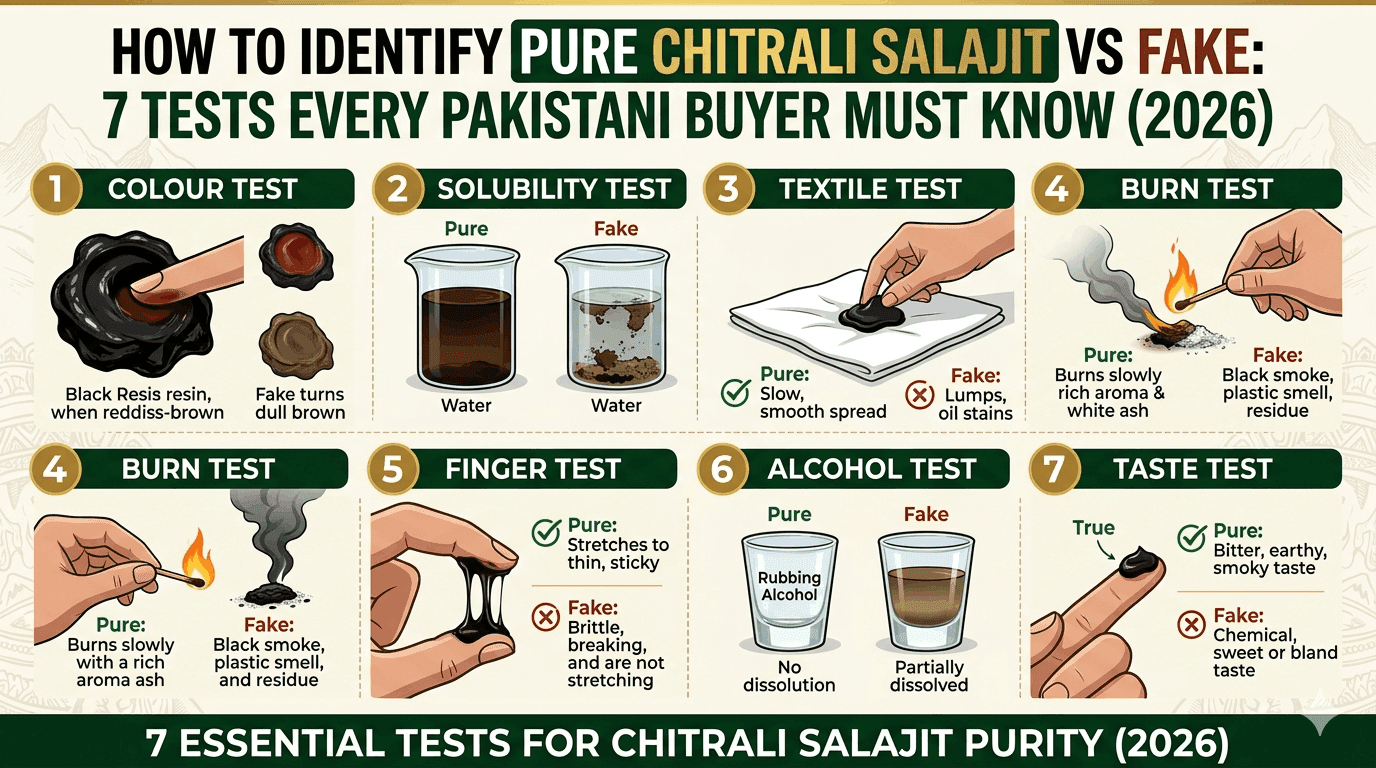
7 At-Home Tests to Verify Your Salajit Is Real
You do not need a laboratory to perform these basic authenticity checks. Every one of these tests can be done at home in under five minutes.
Test 1: The Warm Water Dissolution Test ✅
How to do it: Take a small pea-sized amount of Salajit (about 300–500mg) and drop it into a glass of warm (not boiling) water. Stir gently.
What genuine Salajit does:
- Dissolves completely within 1–3 minutes
- Turns the water a rich golden-amber to dark brown color
- No visible residue, sediment, or floating particles remain
- The dissolved solution has a characteristic earthy, slightly bitter aroma
What fake Salajit does:
- Leaves behind undissolved gritty residue (mineral powders, fillers, soil)
- May turn the water a murky, inky black rather than golden-amber
- Might float or break into oily droplets rather than fully dissolving
- May have a chemical or musty smell rather than an earthy mineral one
Verdict: This is the single most reliable at-home test. If it doesn't dissolve cleanly — it's not pure.
Test 2: The Flame Test 🔥
How to do it: Take a small amount of Salajit and hold it over a lighter flame or candle.
What genuine Salajit does:
- Does NOT catch fire or burn with a proper flame
- Bubbles, puffs up slightly, and emits a thin wisp of smoke
- May produce a small ember-like glow without sustained burning
- Smells earthy when heated — similar to soil after rain (petrichor)
What fake Salajit does:
- Burns with a visible flame (contains petroleum derivatives, wax, or coal tar)
- Melts and drips like plastic or wax
- Produces thick black smoke with a petroleum or chemical smell
Verdict: If your Salajit burns — throw it away. You have tar or a petroleum-based fake.
Test 3: The Temperature Consistency Test 🌡️
How to do it: Hold a small amount in your palm for 30–60 seconds.
What genuine Salajit does:
- Softens noticeably from your body heat
- Becomes sticky and pliable — almost like very thick honey
- Returns to a firm or brittle state when placed in the refrigerator
What fake Salajit does:
- Remains hard and waxy regardless of body heat
- Does not soften or change texture
Verdict: Real Salajit is thermoplastic. Its texture changes dramatically between cold and warm temperatures.
Test 4: The Alcohol Test 🧪
How to do it: Add a small amount of Salajit to rubbing alcohol (isopropyl alcohol).
What genuine Salajit does:
- Does NOT dissolve in alcohol
- Forms a cloudy suspension or separates without dissolving
What fake Salajit does:
- Dissolves readily in alcohol
- Many plant extracts, resins, and waxes used to fake Salajit are alcohol-soluble
Verdict: Real Salajit is water-soluble but NOT alcohol-soluble. This is a key chemical distinction.
Test 5: The Color and Texture Visual Test 👁️
What to look for in genuine Salajit:
- Color ranges from dark brown to black
- Has a semi-gloss to matte finish depending on processing method
- Aftabi (sun-processed) Salajit tends to be lighter brown and slightly more brittle
- Texture is non-uniform — real resin has variation, not a perfectly smooth, uniform appearance
- In resin form: sticky, dense, and aromatic
Red flags:
- Perfectly uniform, shiny, smooth surfaces (suggests molding or synthetic production)
- Bright black color (may indicate coal tar or asphalt)
- Any artificial-looking uniformity
Test 6: The Smell Test 👃
Genuine Chitrali Salajit has a distinctive aroma that is:
- Earthy — similar to wet mountain soil or fertile earth
- Slightly sulfurous — a faint mineral sharpness
- Bitter and complex — not sharp or chemical
Fake Salajit smells:
- Chemical or petroleum-like
- Completely odorless (heavily processed fakes)
- Artificially "herbal" — sometimes scented to mask adulterants
Pro tip: If you've ever smelled real Salajit before, you will never forget the scent. It is unmistakable.
Test 7: Lab Certification — The Gold Standard 🏆
No at-home test replaces a proper third-party laboratory analysis. When buying Salajit online in Pakistan, always ask for or look for:
- Fulvic acid percentage — genuine high-quality Salajit is typically 60–80% fulvic acid
- Heavy metal screening — should show safe levels of lead, arsenic, mercury, and cadmium
- Microbial testing — confirms the product is safe for consumption
- Issuing laboratory — look for a recognized Pakistani or international lab (QCL, SGS, etc.)
Any seller who cannot provide a lab report for their Salajit should be treated with serious skepticism.
5 Red Flags When Buying Salajit Online in Pakistan
Beyond the physical tests, here are the commercial red flags that should make you pause before purchasing:
🚩 Red Flag 1: Suspiciously Low Prices Genuine Salajit is harvested by hand from remote mountain locations. It is not cheap to produce. If a 20g jar is priced under Rs. 500, it almost certainly contains little to no authentic Salajit resin.
🚩 Red Flag 2: No Origin Information Legitimate sellers can tell you exactly where their Salajit comes from — which valley, which mountain range, at what altitude. Vague claims like "from Himalayas" without specifics are a warning sign.
🚩 Red Flag 3: Powder Form Sold as Premium While some legitimate powdered Salajit extracts exist, raw resin in its semi-solid form is the most authentic presentation. Powder can more easily be adulterated — be especially careful with powder sold at premium prices.
🚩 Red Flag 4: Unrealistic Health Claims Genuine Salajit sellers make measured, traditionally-grounded claims. Sellers promising miraculous weight loss, instant fertility cures, or "guaranteed" results within 3 days are often covering up a low-quality product with marketing hype.
🚩 Red Flag 5: No Return Policy A confident, honest seller offers a clear return or refund policy. If a seller won't accept returns on Salajit — they know it won't pass your scrutiny.
Aftabi Salajit vs Regular Salajit: What's the Difference?
A term you'll encounter frequently in the Chitrali Salajit market is "Aftabi" — meaning sun-processed. This refers to Salajit that has been purified using traditional sun-drying methods rather than heat-processing or chemical extraction.
TypeProcessingColorConsistencyPotencyAftabi (Sun-processed)Natural sun-dryingMedium brownMore brittle when coolConsidered highest quality traditionallyRegular ResinMinimal processingDark brown to blackSticky, tar-likeHigh potency if authenticPowder ExtractIndustrial extractionFine black powderPowderVariable — quality depends heavily on source
Traditional Chitrali harvesters consider Aftabi Salajit the premium grade — it has undergone natural concentration and purification by sunlight, which traditional wisdom holds enhances its bioavailability.
How Much Does Genuine Chitrali Salajit Cost in 2026?
A rough guide to fair market pricing for authentic Chitrali Salajit in Pakistan:
- 10g jar: Rs. 1,200 – Rs. 2,500
- 20g jar: Rs. 2,200 – Rs. 4,500
- 30g jar: Rs. 3,500 – Rs. 6,500
Anything significantly cheaper than these ranges should raise immediate questions. Anything significantly more expensive should be accompanied by premium certifications or exceptional provenance documentation.
How to Use Pure Chitrali Salajit Correctly
Once you've verified your Salajit is genuine, here's how to use it:
Daily Dosage: A pea-sized amount (300–500mg) once daily is the standard traditional recommendation. More is not necessarily better — Salajit is potent.
Best Method: Dissolve in warm (not boiling) water, milk, or herbal tea. Never take with chlorinated tap water — use filtered or boiled-and-cooled water.
Best Time: Many users find morning consumption (before or with breakfast) provides the best energy and focus benefits throughout the day.
Duration: Traditional use recommends cycles of 6–8 weeks on, followed by a 2-week break, though this varies by individual.
Caution: Those with hemochromatosis (iron overload), pregnant women, and people with active autoimmune conditions should consult a doctor before use.
❓ Frequently Asked Questions About Chitrali Salajit
What is the difference between Salajit and Shilajit?
They are the same substance — Salajit is the Urdu/Pakistani term while Shilajit is the Sanskrit/Hindi term used more widely in India and international wellness markets. In Chitral's local Khowar language, it is called "Zomu Ashro."
Is Chitrali Salajit safe to use every day?
When genuine and lab-tested, yes — traditional use in Chitral involves daily consumption, and centuries of use support its safety profile. Always ensure your source is verified and tested for heavy metals.
Can women use Salajit?
Yes. While Salajit has been historically more marketed to men, research suggests it supports hormonal balance, bone health, iron levels, and energy in women as well.
How long does it take to feel the effects of Salajit?
Most users report noticeable improvements in energy and focus within 2–4 weeks of consistent daily use. Results vary based on individual health status and the quality of Salajit used.
Where can I buy genuine Chitrali Salajit online in Pakistan?
Chitral Hive sources verified Chitrali Salajit directly from trusted mountain harvesters. All our Salajit products come with transparency about sourcing and quality standards. Shop Chitrali Salajit at Chitral Hive →
🏔️ The Bottom Line
The Salajit market in Pakistan rewards informed buyers. Armed with the 7 tests in this guide, you are far better equipped to separate genuine Chitrali resin from the many fakes competing for your attention and your rupees.
The rule is simple: if a seller can't answer where their Salajit comes from, can't show a lab report, and can't tell you why their price makes sense — keep walking.
At Chitral Hive, we stake our reputation on the authenticity of every product we sell. Explore our verified Chitrali Salajit collection and experience the real thing.
🛒 Shop Pure Chitrali Salajit → chitralhive.com
Published by the Chitral Hive Team | support@chitralhive.com | +923239119309