
Chitrali Cap (Pakol) Complete Guide 2026: History, Types, How to Wear & Where to Buy Authentic Online in Pakistan
April 16, 2026
Chitral Hive
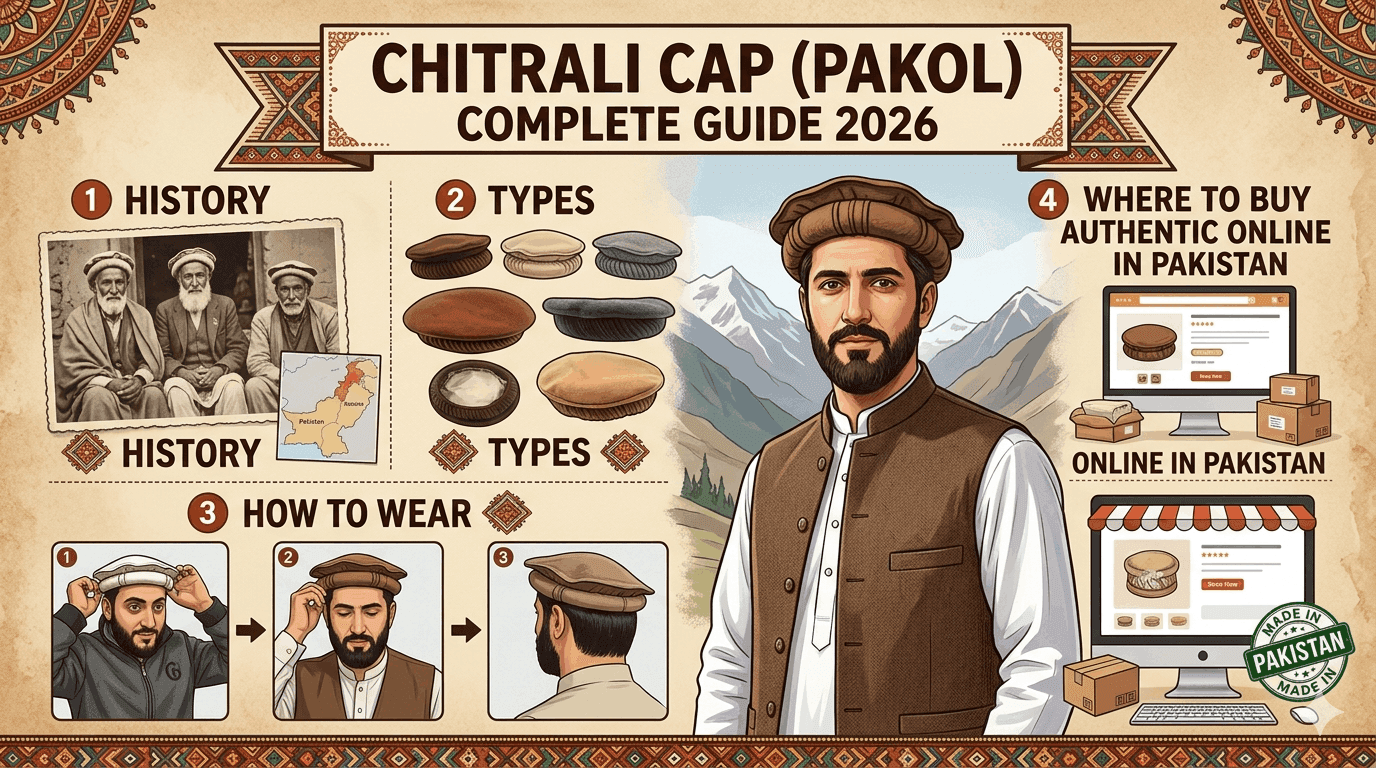
The Cap That Conquered the World's Highest Mountains
Few items of clothing carry the cultural weight and global recognition of the Chitrali Cap, known locally as the Pakol (also spelled Paqul or Pakul). Flat-crowned, soft-brimmed, and made from hand-rolled natural wool, this cap is the defining headwear of northern Pakistan's mountain cultures — and one of the most identifiable symbols of the entire Hindu Kush–Himalayan region.
It has been worn by:
- Chitrali tribesmen for centuries in the valleys of the Hindu Kush
- Ahmad Shah Massoud — the legendary Afghan commander whose Pakol made the cap globally famous
- Pakistani mountaineers on some of the world's most extreme peaks
- Urban Pakistanis increasingly embracing it as a cultural fashion statement
- International travelers who take it home as their most meaningful Pakistan souvenir
In 2026, interest in the Chitrali Cap has never been higher — both as a heritage piece and as an increasingly fashionable winter accessory. This guide tells you everything you need to know about it.
The History of the Chitrali Pakol — Where Did It Come From?
The exact origin of the Pakol is debated by historians, but several theories are well-documented:
The Chitrali Origin Theory: Most ethnographers and textile historians trace the Pakol to the mountain communities of Chitral district in what is now Khyber Pakhtunkhwa, Pakistan. The cap's design — a flat crown with a thick rolled brim — was adapted to the specific requirements of mountain life: warmth without bulk, stability in high winds, and easy storage (the brim can be rolled up or pulled down as needed).
The Greek Connection: Some historians connect the Pakol's design to the kausia — the flat, broad-brimmed hat worn by soldiers in Alexander the Great's Macedonian army, which marched through this exact region in 327 BCE. Alexander's campaigns brought Greek soldiers to Chitral's mountain passes, and some cultural historians believe the cap's basic form has persisted in this region for over 2,300 years.
The Nuristani–Chitrali Continuum: Archaeological and ethnographic evidence suggests the Pakol was worn across the broader Nuristani–Chitrali cultural region — encompassing modern northeast Afghanistan and northern Pakistan — for many centuries before it became widely known outside the region.
Regardless of its precise origin, by the 19th century the Pakol was firmly established as the signature headwear of Chitral's men, and it has remained so ever since.
How Ahmad Shah Massoud Made the Pakol Famous
No individual did more to bring global attention to the Pakol than Ahmad Shah Massoud — the Northern Alliance commander who led Afghan resistance against the Soviet occupation and later the Taliban. His distinctive appearance — always wearing a Pakol pushed slightly back on his head — was captured in photographs that circulated worldwide throughout the 1980s and 1990s. After his assassination in 2001, the Pakol became a global symbol of his legacy and, by extension, of the mountain cultures of the Hindu Kush.
Anatomy of a Genuine Chitrali Pakol — What Makes It Authentic?
Understanding the construction of a genuine Pakol is the first step to identifying one:
The Crown: A circular flat top — traditionally made from the same wool as the rest of the cap. In higher-quality pieces, the crown may be reinforced with a thin lining.
The Rolled Brim: The defining feature. The brim is made from a long strip of wool fabric that is rolled multiple times to create the thick, distinctive band. In a genuine handmade Pakol, this rolling is done entirely by hand — a skilled artisan can take several hours to complete a single high-quality cap.
The Wool: Traditional Pakols are made from natural sheep's wool. The finest varieties use wool from Chitrali or Swati sheep, which produces a naturally lanolin-rich fiber that is both water-resistant and extremely durable.
The Finish: Genuine handmade Pakols have slight asymmetries — no two are exactly alike. The stitching is visible and imperfect in a way that signals hand-production. Machine-made fakes are symmetrically perfect and feel plasticky or stiff.
Types of Chitrali Caps — Not All Pakols Are the Same
There is significant variation within the Pakol category that most buyers are unaware of:
1. Classic Chitrali Pakol (Traditional Style)
The original form — a moderate crown height with a generously rolled brim. Available in the traditional colors: off-white/cream (the most culturally traditional), medium brown, and charcoal gray.
Best for: Traditional cultural wear, formal occasions, elder males, and cultural authenticity.
2. Afghan Pakol (Slightly Different Profile)
Popularized through the Soviet-Afghan war era, the Afghan variant tends to have a slightly higher crown and a less generously rolled brim. It is the style most widely seen in international media.
Best for: Fashion-forward wear; often preferred by younger urban wearers.
3. Chitrali Wool Cap (Closed Top / Knitted Variant)
A different style from the same region — a fully knitted, dome-shaped cap rather than the flat-topped rolled Pakol. Often features simple geometric patterns in two or three colors.
Best for: Cold weather, casual wear, gifting to children.
4. Premium Pattoo-Wool Pakol
The highest quality Pakol — made from hand-spun, hand-loomed Chitrali pattoo fabric rather than standard knitted wool. Denser, warmer, and significantly more durable. Typically only available directly from Chitrali artisan producers.
Best for: Collectors, premium gifting, and buyers who want the finest possible quality.
Chitrali Cap Colors and What They Mean
Color carries cultural significance in the Pakol world:
ColorCultural SignificanceBest ForOff-White / CreamMost traditional; worn at weddings, religious occasionsFormal events, cultural ceremoniesNatural Brown / TanEveryday traditional wearGeneral daily useCharcoal GrayMore urban/modern; growing in popularityCity wear, younger buyersDark Brown / BlackLess common; often associated with winter useWinter warmth, fashion-forwardMulticolor PatternsNuristani-influenced; regional variationsCasual wear, gifting
How to Wear a Chitrali Pakol — The Right Way
The Pakol is versatile in how it can be positioned, and each style communicates something slightly different:
The Classic Chitrali Tilt: Worn squarely on the head with the brim rolled up all around and the cap sitting level or tilted very slightly back. This is the traditional Chitrali elder's style — dignified and formal.
The Massoud Back-Tilt: Pushed slightly toward the back of the head, exposing the forehead. This is the style made famous by Ahmad Shah Massoud and is the most recognizable internationally. It communicates both authority and informality.
The Pulled-Down Winter Style: The brim can be fully or partially unrolled downward to cover the ears and forehead in cold weather. This transforms the cap into a functional cold-weather hat — one of its great practical advantages over more rigid headwear.
The Urban Fashion Angle: Worn at a diagonal angle over one ear, slightly forward. A style popular with younger Pakistanis incorporating the Pakol into streetwear-influenced outfits.
Fake vs. Real Chitrali Caps — 5 Ways to Tell the Difference
The market is full of machine-made synthetic "Pakol" caps that look similar but are inferior in every meaningful way. Here's how to tell the difference:
✅ Genuine Handmade Chitrali Cap:
- Slight, natural asymmetry in the rolled brim — no two are identical
- Natural wool fiber — slightly rough to the touch, smells faintly of natural lanolin
- Visible hand-stitching with slight imperfections
- Brim feels dense and compressed from hand-rolling
- Softens and shapes to your head after a few wears
❌ Machine-Made Fake:
- Perfectly symmetrical — machine-pressed uniformity is the giveaway
- Synthetic fiber — unnaturally smooth, may feel slightly plasticky
- Machine stitching — perfect, even, and soulless
- Brim feels light and hollow compared to hand-rolled density
- May shed fiber or lose shape quickly
The Wool Burn Test (for the committed buyer): Pull a single fiber from the cap and hold it to a flame. Natural wool burns slowly, curls away from the flame, smells like burned hair, and produces a crushable ash. Synthetic fiber burns fast, melts, smells chemical, and produces a hard bead of plastic.
How to Care for Your Chitrali Pakol
With proper care, a genuine handmade Chitrali Pakol lasts for many years — sometimes decades:
- Hand wash only in cold water with gentle wool-safe soap
- Never machine wash — agitation destroys the rolled brim structure
- Reshape while damp — gently reform the brim and crown with your hands and allow to air dry on a rounded surface
- Store flat or on a hat stand — do not crush under heavy objects
- Brush lightly with a soft clothes brush to remove surface dust and maintain the wool's appearance
- Avoid prolonged direct sunlight — UV exposure causes natural wool to yellow and weaken over time
A well-cared-for genuine Chitrali Pakol actually improves with age — the wool softens, the brim settles perfectly to your head shape, and the cap develops a beautiful, lived-in character.
The Chitrali Pakol in Modern Pakistani Fashion
In recent years, the Pakol has been experiencing a genuine cultural renaissance in Pakistan's cities. Urban Pakistanis — particularly in Islamabad, Lahore, and Peshawar — are increasingly wearing the Pakol as a fashion item that expresses Pakistani heritage identity in a globalized world.
This trend intersects with a broader global movement toward heritage fashion: the embracing of traditional textiles and garments as an alternative to fast fashion. In this context, the Chitrali Pakol is perfectly positioned — it is one of Pakistan's most distinctive, most photogenic, and most culturally layered fashion items.
It has appeared in Pakistani fashion editorials, been worn at international cultural events, and is increasingly a sought-after item among the Pakistani diaspora who want to maintain cultural connection through dress.
Chitrali Cap as a Gift — Why It's One of Pakistan's Best Cultural Gifts
As covered in our gift guide, the Pakol is one of the most thoughtful and practical gifts you can give in Pakistan:
- It is genuinely useful — warm, durable, every-day wearable
- It is culturally meaningful — carries a story and history most people love to share
- It is universally appreciated across age groups (from teenagers to grandfathers)
- It is unlike anything else typically given as a Pakistani gift
- It is available at accessible price points without compromising on quality
🛒 Shop Authentic Chitrali Pakol Caps at Chitral Hive →
❓ Frequently Asked Questions About the Chitrali Cap
What is the Chitrali cap called?
The traditional Chitrali cap is called a Pakol (also spelled Pakul or Paqul). In Khowar (the local Chitrali language) it has traditional regional names. In Urdu-speaking Pakistan, it is often called the Chitrali topi.
What is the Chitrali cap made of?
Authentic Chitrali Pakols are made from natural sheep's wool — either hand-spun and hand-rolled or, in more traditional premium versions, made from hand-loomed Chitrali pattoo fabric. Quality caps use wool from local Chitrali or Swati sheep breeds.
How much does an authentic Chitrali cap cost in Pakistan?
Genuine handmade Chitrali Pakol caps typically range from Rs. 600 to Rs. 2,500 depending on quality, wool grade, and craftsmanship. Premium pattoo-fabric versions may cost more. Anything significantly cheaper is almost certainly machine-made synthetic.
Can women wear a Chitrali Pakol?
Yes — and increasingly do. While traditionally a men's hat, the Pakol's design translates beautifully for women as well, particularly in urban fashion contexts. Several Pakistani women fashion influencers have incorporated the Pakol into editorial and street style looks.
Where can I buy a genuine handmade Chitrali Cap online in Pakistan?
Chitral Hive sources authentic handwoven Pakol caps directly from Chitrali artisans and delivers across Pakistan. Shop Chitrali Caps at Chitral Hive →
What size Chitrali cap should I buy?
Most Pakols are one-size with some adjustability due to the flexible rolled brim. If you are between sizes, the brim can be adjusted by rolling it tighter or looser. When in doubt, size up slightly — it is easier to tighten a Pakol than to stretch one.
🏔️ More Than a Hat — A Living Piece of Culture
When you wear or give a genuine Chitrali Pakol, you are participating in a cultural tradition that has survived over a thousand years of mountain history. It crossed the paths that Alexander's armies marched, warmed the heads of warriors and shepherds, and now finds new meaning on the streets of Pakistan's modern cities.
In an age of disposable fast fashion and mass-produced accessories, the handmade Chitrali Pakol stands for something different: craftsmanship, endurance, and identity.
Buy genuine. Buy direct. Buy from Chitral Hive.
🛒 Shop Authentic Chitrali Caps → chitralhive.com
Published by the Chitral Hive Team | support@chitralhive.com | +923239119309