
Chitral Valley Travel Guide 2026: What to See, What to Buy & How Chitral Hive Brings the Best of Chitral to You
April 16, 2026
Chitral Hive
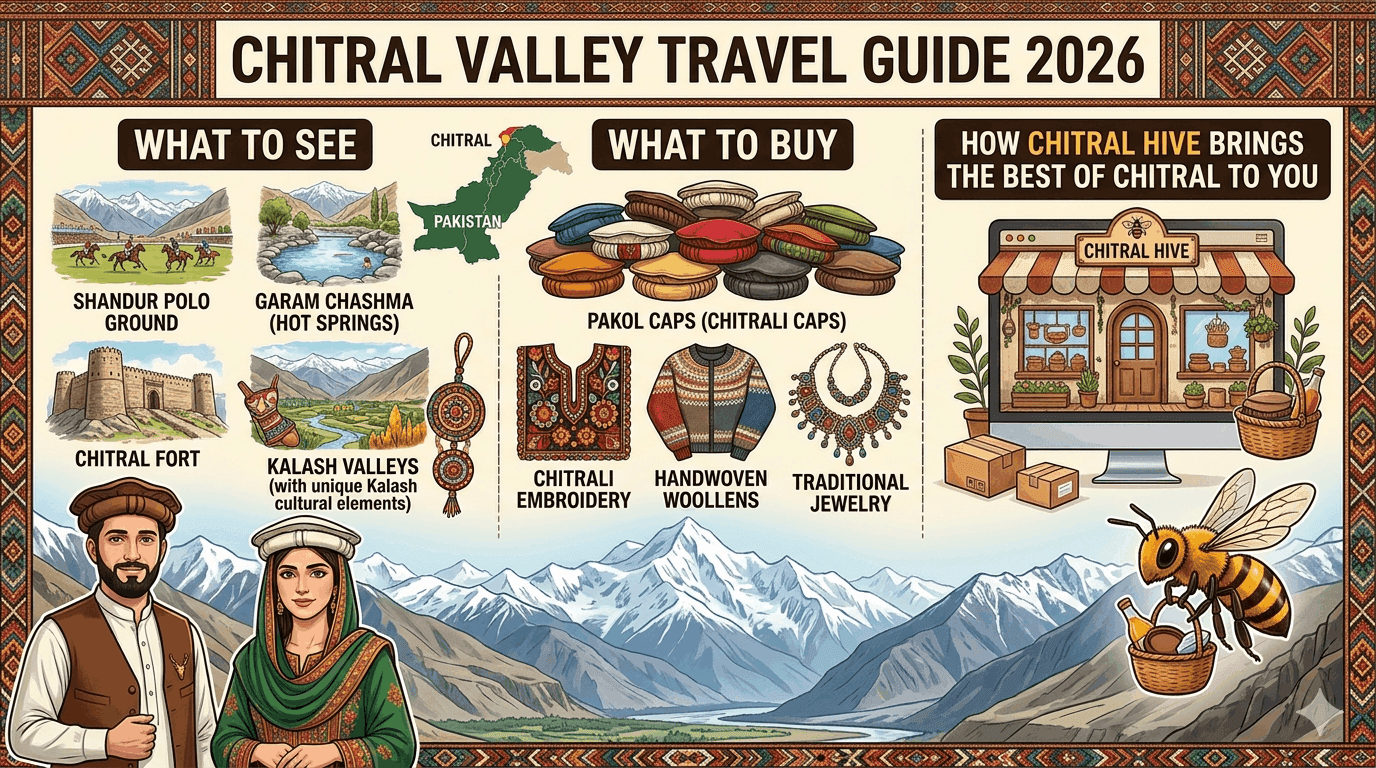
Chitral — Pakistan's Most Underrated Destination
Every Pakistani knows the names: Lahore, Karachi, Islamabad, Murree. Many know Hunza and Swat. But Chitral — tucked into the far northwest of KPK, bordering Afghanistan to the north and west, cradled by the Hindu Kush mountains — remains one of Pakistan's most genuinely extraordinary places that most Pakistanis have never visited.
This is beginning to change. Chitral's tourism numbers have grown significantly over the past decade as Pakistanis and international visitors discover:
- A living culture that predates the arrival of Islam by centuries — embodied by the Kalash people, Pakistan's ancient indigenous community
- Mountain landscapes of staggering beauty — including Pakistan's highest polo ground at Shandur Pass (3,734 meters)
- Wildlife found nowhere else in Pakistan — snow leopards, markhor, golden eagles
- A food culture built around organic mountain produce that has never been adulterated by industrial agriculture
- Artisan traditions in wool weaving, embroidery, and woodcarving that produce some of Pakistan's finest crafts
If you can travel to Chitral in 2026 — you should. This guide tells you exactly how and what to expect. And if you can't travel — Chitral Hive brings the best of Chitral's products directly to you.
Essential Chitral Geography — Understanding Where You're Going
Chitral is Pakistan's largest district by area — covering 14,850 square kilometers of some of the world's most dramatic mountain terrain. It is bordered by:
- Afghanistan (Nuristan and Badakhshan provinces) to the north and west
- Gilgit-Baltistan to the northeast
- Dir district to the southeast
The district sits at the convergence of three great mountain systems: the Hindu Kush, the Karakoram, and the westernmost extensions of the Himalayas. Tirich Mir — at 7,708 meters the highest peak of the Hindu Kush — dominates the northern horizon from Chitral city.
The Chitral River (Kunar River) runs through the valley from north to south, creating the fertile river corridor where the majority of Chitral's population lives. Side valleys branch off this main corridor, each with its own distinct micro-culture, dialect variation, and ecological character.
Elevation range: From approximately 1,100 meters at the southern border to over 7,700 meters at Tirich Mir's summit — an extraordinary ecological gradient that creates the biodiversity responsible for Chitral's exceptional natural products.
How to Get to Chitral — The 2026 Guide
By Air
PIA operates direct flights from Peshawar to Chitral — weather permitting. The flight takes approximately 45–55 minutes and offers one of Pakistan's most spectacular aviation experiences, flying directly over the Hindu Kush at close range. Flight availability is seasonal and weather-dependent — Chitral Airport is surrounded by mountains and flights are frequently cancelled in poor visibility.
Practical tips:
- Book well in advance during peak season (July–September)
- Always have a road journey backup plan — flight cancellations are common
- The PIA Chitral flight is one of Pakistan's most scenic — request a window seat
By Road
Route 1: Via Dir and Lowari Tunnel (Year-round) The primary road access to Chitral runs through Dir district via the Lowari Tunnel — a 8.5km tunnel that opened the road in winter months for the first time in Chitral's history. The journey from Peshawar takes approximately 8–10 hours depending on road conditions.
- Peshawar → Chakdara → Dir Town → Lowari Tunnel → Chitral
- Road quality has improved significantly in recent years but remains mountain road standard — switchbacks, narrow sections, and occasional landslides in monsoon season
Route 2: Via Shandur Pass (Summer Only, June–September) For the adventurous: the legendary Shandur–Gilgit road traverses Shandur Pass (3,734m) and is open only in summer. This is one of Pakistan's great road journeys — breathtaking scenery, minimal traffic, and the chance to experience Shandur before or after the famous polo tournament.
- Gilgit → Gupis → Teru → Shandur Pass → Mastuj → Chitral
- Allow 2 days minimum; camping at Shandur is one of Pakistan's great travel experiences
Top 10 Things to See and Do in Chitral
1. 🏰 Chitral Fort (Shahi Qila) — Living History
The Chitral Fort is the historic seat of the Mehtar of Chitral — the hereditary ruler of the Chitrali state that existed as a princely state under British protection until Pakistan's independence. The fort witnessed one of British India's most dramatic sieges in 1895, when a small British-led garrison held out for 46 days.
The fort complex includes the original fortified palace, watchtowers, and adjacent structures that provide a window into Chitral's royal history. The area around the fort is the heart of Chitral city's bazaar district.
What to buy nearby: Chitrali bazaars around the fort are the best place to find authentic Pakol caps, traditional jewelry, and local dry fruits — though authenticity varies widely; Chitral Hive's online store offers a verified alternative for those shopping remotely.
2. 🏔️ Shandur Pass — The Roof of the World's Polo Field
At 3,734 meters elevation, Shandur Pass is the world's highest polo ground — a title that captures something essential about Pakistan's mountain cultures: that even at the edge of human habitability, life, sport, and celebration continue.
The Shandur Polo Festival (typically held in July) is one of Pakistan's most extraordinary cultural events — teams from Chitral and Gilgit-Baltistan compete in a game played since at least the 17th century, watched by spectators who camp on the high plateau under the Hindu Kush sky.
Even outside festival season, the drive up to Shandur is spectacular and the camping opportunities at the plateau are among the finest in Pakistan.
3. 🎭 Kalash Valleys — Pakistan's Ancient Culture
The Kalash people of the three valleys of Bumburet, Rumbur, and Birir are Pakistan's most culturally unique community — a pre-Islamic indigenous people who have maintained their ancient religion, language, dress, and festivals through centuries of surrounding Muslim culture. Their population of approximately 3,500–4,000 people makes them one of the smallest living indigenous cultures in Asia.
Visiting the Kalash valleys is a genuinely profound experience — a step into a world that has survived against extraordinary odds. Three major festivals mark the Kalash calendar:
- Chilimjusht (May/June): Spring festival celebrating the return of the flocks to summer pastures
- Uchaw (August): Harvest festival
- Chaumos (December): Winter solstice festival — the most elaborate and sacred
Visitor etiquette: Dress modestly, ask permission before photographing people, purchase Kalash crafts directly from artisan-sellers to support the community directly. Do not bring alcohol into the valleys — this is both culturally respectful and increasingly a formal request from the Kalash community.
4. 🌲 Garam Chashma — The Hot Springs Retreat
40 kilometers north of Chitral city, Garam Chashma (literally "hot spring") is a village with naturally occurring hot sulfur springs used for centuries by locals for healing. The springs, combined with beautiful surrounding scenery, make Garam Chashma a pleasant detour or overnight stop.
The route north of Garam Chashma continues toward the Afghan border through increasingly dramatic mountain scenery — the Yarkhun Valley, one of Chitral's most beautiful and least-visited areas.
5. 🦅 Tirich Mir Viewpoints — The Hindu Kush's Monarch
Tirich Mir (7,708m) is not visible from Chitral city itself but dominates the horizon from numerous viewpoints accessible by short drives and hikes from the city. The mountain was first summited by a Norwegian expedition in 1950.
For trekkers and mountaineers, Chitral offers access to serious alpine objectives — but simply seeing Tirich Mir from below, in the early morning light when its glaciated flanks glow gold, is one of Pakistan's most breathtaking natural moments.
6. 🌸 Chitral Bazaar — The Living Market
Chitral's main bazaar is one of the most culturally rich markets in Pakistan — a living crossroads where Chitrali, Nuristani, Wakhi, Kalash, and Khowar cultures converge. Key purchases:
- Pakol caps (verify handmade quality — see our cap guide)
- Chitrali dry fruits — almonds, walnuts, dried apricots, mulberries
- Salajit — buy carefully; fakes are common even in Chitral itself
- Woolen pattoo fabric by the yard
- Traditional jewelry — Chitrali silver and semi-precious stone work
- Wooden carved items — furniture, decorative pieces
7. 🏞️ Mastuj Valley — The Road Less Traveled
The Upper Chitral district centered on Mastuj is one of Pakistan's most scenically spectacular and least touristed areas. The Yarkhun River valley, Laspur Valley, and the road to Shandur all pass through areas of extraordinary natural beauty with minimal visitor infrastructure — meaning genuine wilderness experience.
8. 🕌 Shahi Masjid (Chitral's Royal Mosque)
Adjacent to the Chitral Fort, the Shahi Masjid is a beautiful example of traditional Chitrali mosque architecture — wooden columns, carved decorations, and a serene courtyard that reflects the region's unique synthesis of Central Asian and South Asian design traditions.
9. 🐾 Snow Leopard Territory — Wildlife Watching
Chitral's high-altitude wilderness is one of Pakistan's most important snow leopard habitats. While sighting a snow leopard requires significant luck and patience, the broader wildlife of Chitral's mountains — markhor (Chitral's iconic wild goat and Pakistan's national animal), ibex, golden eagles, and the rare Himalayan lynx — makes wildlife watching a rewarding activity throughout the district.
10. 🎋 Shishi Lake — The Hidden Gem
Shishi Lake in the Mulkhow valley is one of Chitral's most beautiful and least-known high-altitude lakes. A half-day hike from the road access point brings visitors to a brilliantly blue glacial lake surrounded by wildflowers in summer — one of those places that reminds you why Pakistan's mountains are worth every difficult kilometer.
What to Buy in Chitral — The Insider's Shopping Guide
For those visiting Chitral, here is the definitive list of what to bring home:
Priority purchases:
- Sun-dried apricots — buy directly from homes or small village sellers if possible; the freshest and most authentic will have been dried in the current season
- Hand-rolled Pakol cap — take time to examine multiple options; genuine hand-rolled feels significantly different from machine-made
- Pure Salajit — only from trusted sellers with lab documentation; fakes exist even in Chitral city
- Chitrali walnuts — in season (September–October), buy directly from farm families
- Woolen pattoo fabric — sold by the meter at traditional weavers' shops in bazaar
What to avoid: Salajit without documentation, "tourist-grade" crafts made for the tourist trade rather than local use, and mass-produced caps sold as handmade.
Can't Travel to Chitral? Chitral Hive Brings It to You
Not everyone can make the journey to the Hindu Kush — but everyone can experience what Chitral produces. Chitral Hive was built precisely for this: to create a verified, trustworthy bridge between Chitral's producers and artisans and the rest of Pakistan.
Every product on Chitral Hive is:
- ✅ Directly sourced from verified Chitrali producers
- ✅ Authentic — not tourist-grade or commercially substituted
- ✅ Delivered nationwide across Pakistan
- ✅ Backed by our customer satisfaction guarantee
Whether you're in Karachi, Lahore, Islamabad, or anywhere else in Pakistan — Chitral's apricots, almonds, walnuts, honey, Salajit, and handwoven caps can be at your door within days.
🛒 Shop Authentic Chitral Products → chitralhive.com
❓ Frequently Asked Questions
What is the best time to visit Chitral?
May to September is the ideal window — passes are open, weather is pleasant, and summer festivals (including the Shandur Polo Festival in July) are active. October offers beautiful autumn foliage and post-summer harvest. November to March is cold and access-limited, though experienced winter travelers can still reach Chitral through the Lowari Tunnel.
Is Chitral safe to visit in 2026?
Chitral is generally considered one of the safer districts in KPK for tourists. The area has had a stable security environment for several years. Standard travel precautions apply — register with local authorities if trekking in remote areas, keep your embassy/consulate informed if you're a foreign visitor, and check current government travel advisories.
How many days do you need to see Chitral properly?
A minimum of 5–7 days is recommended to see Chitral city, the Kalash valleys, and one or two additional areas like Garam Chashma or the road toward Mastuj. 10–14 days allows for the Shandur Pass route and a more complete experience.
Can women travel to Chitral?
Yes — Chitral has a long tradition of hospitality to travelers and is generally welcoming. Women travelers (both Pakistani and international) visit regularly. Modest dress is recommended throughout Chitral and is strongly advised when visiting the Kalash valleys out of respect for local culture.
Where can I buy authentic Chitrali products if I can't travel to Chitral?
Chitral Hive delivers verified Chitrali products — dry fruits, Salajit, handwoven caps, wool products, and more — across all of Pakistan. Shop at Chitral Hive →
🏔️ Chitral Awaits — In Person or Through Its Products
Chitral is one of those places that changes people. Its mountains impose a perspective that urban Pakistani life rarely permits. Its people — warm, dignified, and deeply rooted — remind you of what community and culture can look like when they haven't been disrupted by a century of rapid change.
Visit if you can. And in the meantime — bring Chitral to your doorstep.
🛒 Shop Authentic Chitrali Products → chitralhive.com
Published by the Chitral Hive Team | zuhooruddin055@gmail.com | +923239119309